

Guru Dutt Movies That Stay With You: A Personal Essay on Pyaasa


A personal essay
The Confession That Never Ages
The first thing that comes to my mind when I think about Pyaasa is not the plot, not even the poetry in isolation, but an image that feels almost like a memory I never lived, something that, in many ways, defines the quiet intensity of Guru Dutt movies.
Guru Dutt, dressed in white, leaning against a dark bookshelf, half in shadow and half in light, singing “Jaane Woh Kaise Log The Jinke Pyaar Ko Pyaar Mila…” and in that moment, it does not feel like a performance, it feels like a confession that has slipped out of a man who has stopped trying to hide, and perhaps that is why this film does not age, because confessions do not age, they linger.
All the songs in Pyaasa are not interruptions, they are not ornamental detours meant to entertain or to soften transitions, they are the film itself unfolding in another language, the language of ache; and when you listen to the words written by Sahir Ludhianvi, you realize that they are not lyrics placed into a narrative, they are wounds that the narrative is built around, and every time I return to this film, which has been many times now, so many that I have stopped counting, I do not feel like I am rewatching something, I feel like I am returning to a version of myself that once needed this film to survive something unnamed.

This write-up is not just a tribute, because tribute feels distant and respectful in a formal way, and what I feel towards Pyaasa is neither distant nor formal, it is deeply personal, almost uncomfortable in its honesty, because somewhere along the way, this film stopped being a film and became a companion, a quiet presence that sat beside me in phases of my life where words failed me but silence did not.
The Poet I Recognized Before I Knew His Name
I first watched Pyaasa when I was in college, at a time when my struggle was not just to write, but to understand why I wrote the way I did, because I had a vision, I knew what I wanted to say, I could feel it in my bones, but I did not know how to shape it in a way that would be accepted, I could not write to please, I could only write to purge, to pacify something restless inside me, and that is not something that sells, that is not something that people clap for, and in that phase, Vijay the struggling poet that Guru Dutt plays did not feel like a character, he felt like an extension of a question I was too afraid to articulate.
And it was in that state that the song “Tang Aa Chuke Hain Kashmakash-e-Zindagi Se Hum…” found me, or perhaps I found it, and I remember feeling an odd sense of relief, not because the song offered answers, but because it acknowledged exhaustion in a way that felt dignified, it did not dramatize suffering, it simply sat with it, and sometimes that is all one needs not solutions, just recognition.
On Heartbreak and the Architecture of Love
Then came the phase of my first heartbreak, that peculiar kind of pain that feels both universal and intensely personal, as if the world has conspired to teach you something you never signed up to learn, and when I returned to Pyaasa then, the song that held me was “Jaane Woh Kaise Log The…” and it is difficult to explain what that song does, because it does not merely speak of unrequited love, it questions the very architecture of love itself, it wonders aloud about a world where love is reciprocated, as if that itself is an anomaly, and the way it is picturized with Guru Dutt standing amidst people yet completely alone captures that strange isolation where you are surrounded by voices but none of them reach you.

There is also this detail I had come across, that Guru Dutt in real life wore thick glasses and often chose not to wear them while shooting, which strained his eyes, and whether or not that is entirely accurate, what remains undeniable is the visible tension in his expressions the slight furrow of his brow, the heaviness in his gaze and it always felt to me like he was not acting pain, he was carrying it, and the camera merely witnessed it.
When the World Softened, Briefly
Then, life softened for a while, or at least it felt like it did, because I met someone, someone who made the world seem less indifferent, someone who made me believe, even if briefly, that perhaps things do align, that perhaps longing does not always end in absence, and when I watched Pyaasa in that phase, the song that echoed within me was “Jaane Kya Tune Kahi…” and there is something about Waheeda Rehman as Gulabo that is impossible to articulate fully, because her presence is not just beauty, it is tenderness without demand, affection without condition, and in the monochrome world of Pyaasa, she becomes light itself, not loud or blinding, but steady and patient.
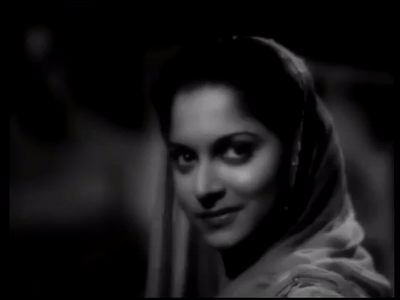
That phase, like most such phases, did not last, but the memory of it remained, layered within the film like a quiet note that resurfaces when you least expect it.
The Marketplace of Values
Then came a different kind of struggle not personal in the conventional sense, but a grappling with the world outside, with the social and political chaos that one tries to make sense of but often fails to, and in that phase, “Yeh Koochay Yeh Neelam Ghar…” became the lens through which I saw not just the film, but the world itself, because the song does not accuse in a loud, aggressive manner, it reveals, it strips away pretense and shows you the marketplace of values where everything art, integrity, even pain is up for negotiation.
And then, inevitably, came a phase of losses of setbacks, of strained relationships, of a kind of quiet disintegration that does not announce itself dramatically but settles in slowly, and it was then that “Yeh Duniya Agar Mil Bhi Jaaye To Kya Hai…” stopped being a song and became an echo of everything I could not say, because that climactic scene, where Vijay stands in the auditorium, arms outstretched, engulfed in shadows and light, rejecting a world that had finally decided to accept him only when it believed him to be dead, is not just cinematic brilliance, it is philosophical rebellion, it is a refusal to equate recognition with meaning.

I remember watching that scene and feeling seen in a way that is almost unsettling, because it confronts you with a question you spend most of your life avoiding what is the worth of achievement if it comes at the cost of authenticity, what is the value of a world that only embraces you when you no longer exist as yourself.
Not a Story About the World. A Story About the Self.
Now, I am aware that many people might view Pyaasa as overly drenched in sorrow, as a film that leans heavily into pain and isolation, but I have often wondered is that really an exaggeration, or is it simply an honest reflection of something we all experience but rarely acknowledge?
Because to me, Pyaasa is not the story of a man struggling against the world, it is the story of a man confronting himself, and that distinction matters, because it shifts the source of pain from the external to the internal, and that is a far more uncomfortable truth, because it suggests that what we suffer from is not merely what happens to us, but how we carry it within us.
Two people can experience the same event and emerge with entirely different scars, and that difference cannot be explained by circumstance alone, it points to something deeper, something internal, something that Pyaasa quietly insists upon that pain is not just inflicted, it is also housed.
The Thirst That Has No Name
At the center of it all lies the idea of pyaas thirst not just for love, or recognition, or success, but for something more elusive, something that perhaps does not even have a name, and it is this thirst that drives us, that wakes us up in the morning with anticipation and puts us to sleep at night with hope, and yet, it is also this very thirst that becomes the source of our unrest, our dissatisfaction, our endless search.
So is it wrong to carry this thirst within us?
I do not think so, because without it, there would be no movement, no creation, no longing that pushes us beyond ourselves, but what Pyaasa reminds us, gently but persistently, is that this thirst is not something we can ever fully quench, it is not a problem to be solved, it is a condition to be understood, and perhaps even accepted.

Because the tragedy is not that we desire, the tragedy is that we expect desire to end, that we believe there will come a point where everything will align perfectly and the restlessness will dissolve, and when that does not happen, we feel betrayed, as if life has failed us, when in reality, it is we who have misunderstood life.
Pyaasa does not offer comfort in the traditional sense, it does not tell you that things will get better, it does not promise resolution, but it offers something far more honest it tells you that what you feel is real, that your contradictions, your longing, your quiet despair, your fleeting joys, all of it is part of the same fabric, and that perhaps the goal is not to escape it, but to recognize it without turning away.


Comments